It’s been a bad few years to be a Washington Nationals fan. Ever since the 2019 World Series, each season has been marked by disappointment: COVID derailing the victory lap year, injuries and trades undermining the 2021 and 2022 seasons, and then a failed rebuild from 2023-2025 resulting in the departures of GM Mike Rizzo and manager Davey Martinez.
Coming off that streak, one might reasonably expect a few more years in the doghouse, getting even worse before finally turning the page towards contention… someone forgot to tell the team though!
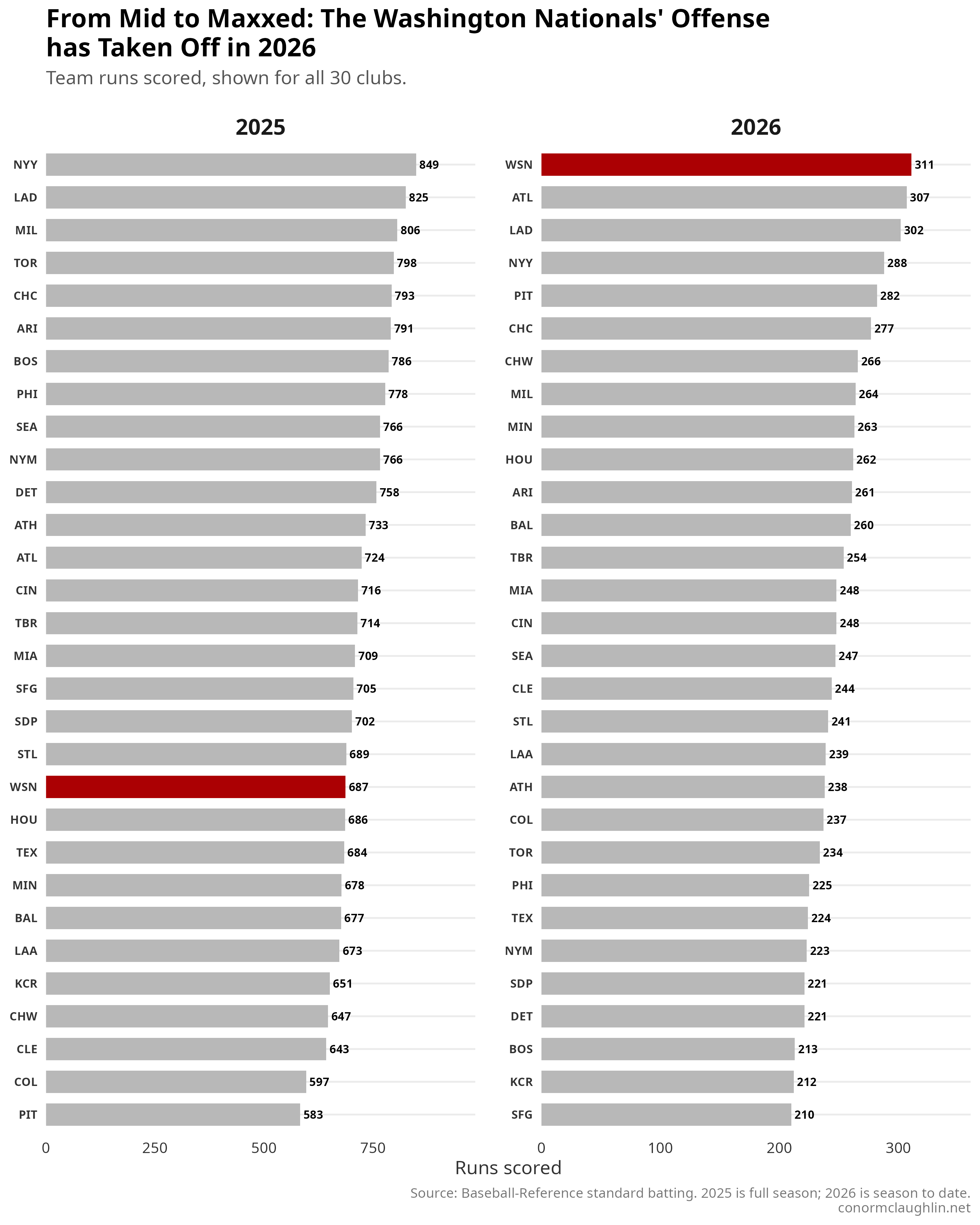
Through the first two months of the 2026 season, they’ve played .500 baseball and have been a real bright spot across the sport, leading baseball with 311 runs scored. Of course, they’ve also allowed the most runs in the league at 317 - but much like The Jameis Winston Experience (tm), that sort of action isn’t the worst thing for fans…
In this post, I’ll do my best to decompose some of the clearest drivers powering their much-improved offense, and highlight a few other notable trends, most notably pinch-hitting, openers, and long relief. Let’s get into it!
Offense
Runs Scored, Year-over-Year (YoY)
Last year, the Nats were a middle-of-the-pack offense - this year, they’ve surged to the highest run total in baseball, just barely ahead of their division rival Braves and reigning champion Dodgers.
Decomposing the Difference in Runs
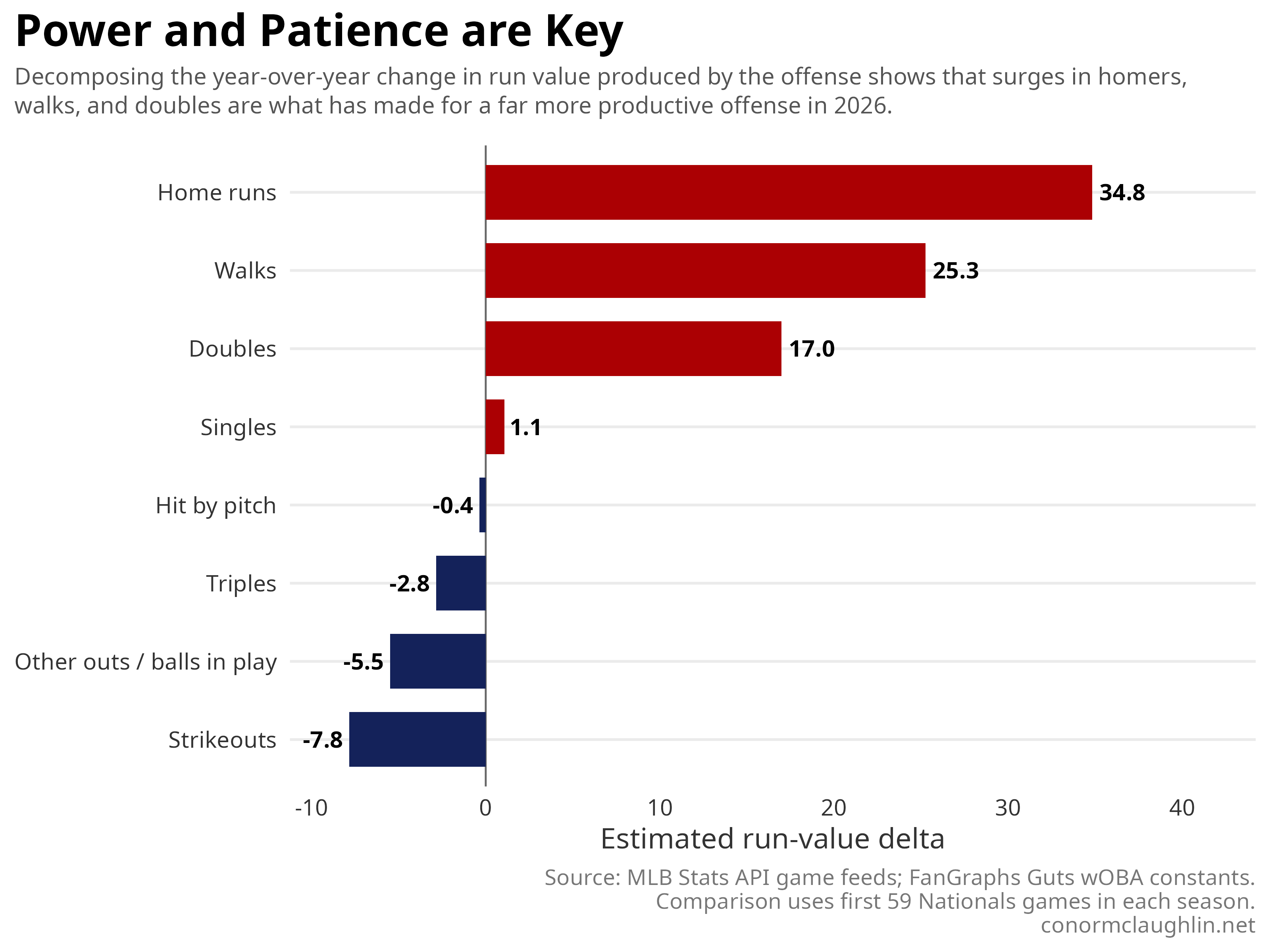
If we look at the difference in “batting runs value” generated this season vs last season, we see that improvements in walks and power hitting are dramatically outweighing the associated increase in strikeouts. All last year I kept saying that the team was too contact oriented, and could look to drive the ball more and not hit as many grounders… you can imagine my brain loved the confirmation bias of this chart:
Organic Improvement - Better Coaching?
I’ll let this quote speak for itself:
“It’s never on coaching. Coaches work their assess off every single day. We’re not going to finger point here and say it’s on the coaches. It’s never on the coaches… Sometimes you got to put the onus on the players.” - Davey Martinez, June 14, 2025
Davey Martinez on the Nationals offensive struggles after their 7th straight loss:
— FOX Sports: MLB (@MLBONFOX) June 14, 2025
"It's never on coaching. Coaches work their assess off every single day. We're not going to finger point here and say it's on the coaches. It's never on the coaches... Sometimes you got to put the… pic.twitter.com/WFt7KrMUs0
Jacob Young
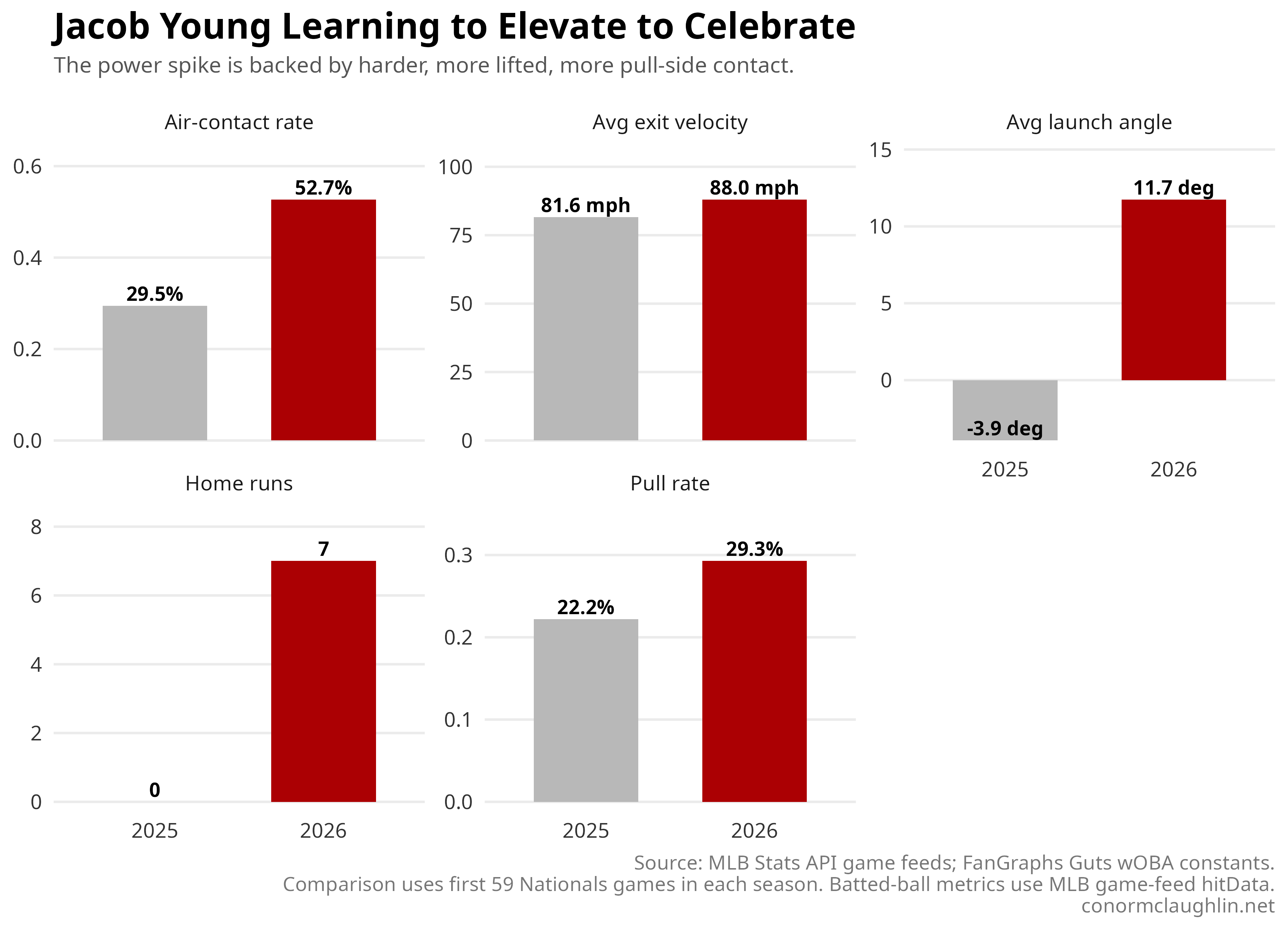
Jacob Young, or as the Nats’ radio guys call him, “Slugging Jacob Young”, is one of the best examples I’ve ever seen for why coaching matters. Last season, Young was hitting almost everything slowly and on the ground, with a negative average launch angle (-3.9 deg) and with only ~30% of his balls hit in the air. Combined with relatively low bat speed, that led to terrible hitting outcomes, with no home runs and only a sprinkle of extra-base hits.
This season, Young has dramatically revamped his swing in a clear attempt to elevate and pull the ball and it’s had fabulous results - Young’s hit seven home runs, is recording average exit velocities +6 mph faster, and has become a real weapon at the bottom of the Nats’ lineup.
Keibert Ruiz
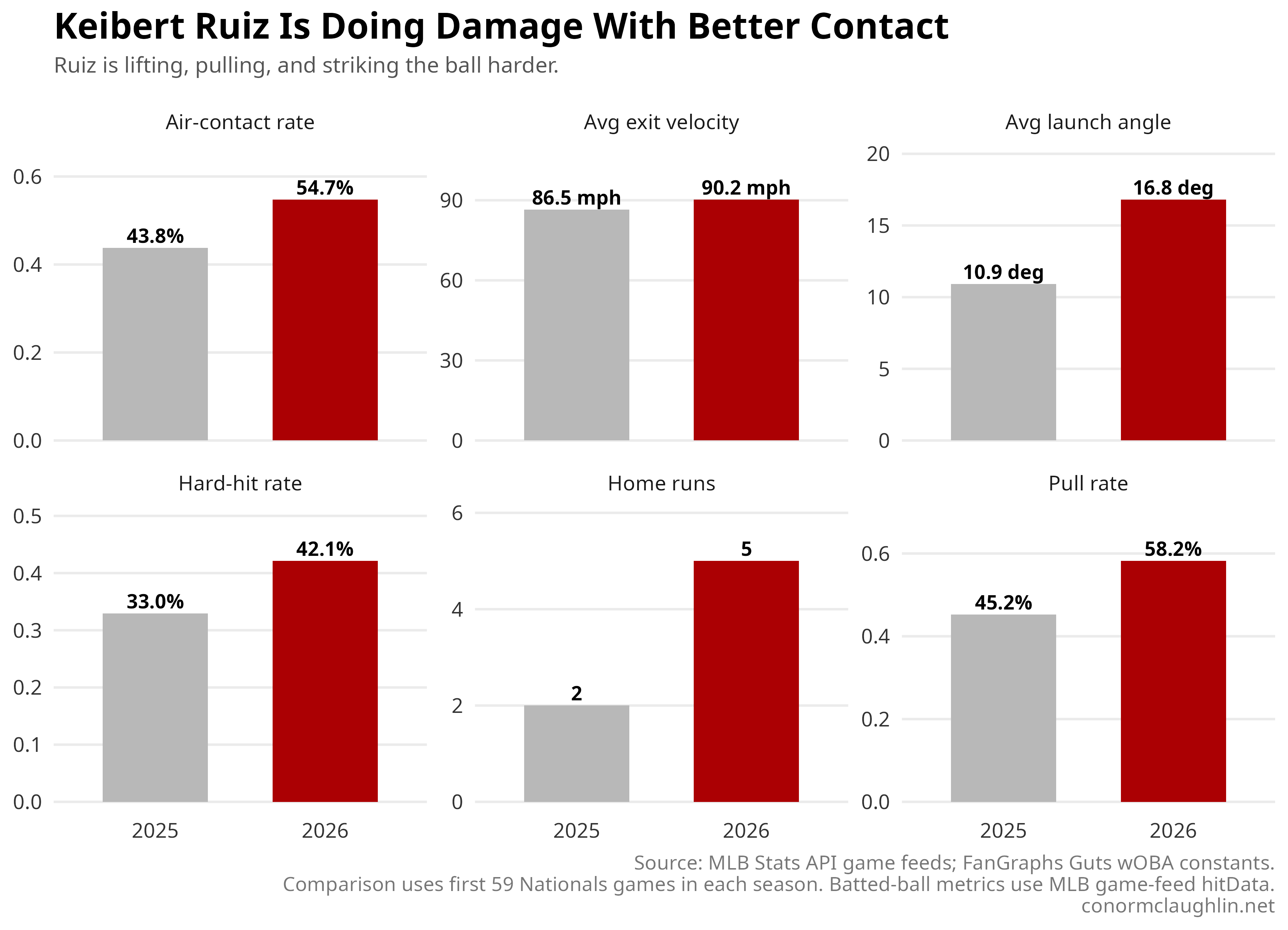
Ruiz’s revitalization is another amazing case study - his player profile for the last few seasons has been that of a slow-swinging contact hitter, able to hit lots of balls, but rarely making hard contact. Because of this, opposing pitchers were able to easily take advantage: just throw him balls out of the zone, and he’ll roll them over or pop them out.
As a fan, this would drive me insane because it’s so clear that Ruiz could be a great hitter if he took a more aggressive, selective approach - trying to drive balls in his wheelhouse, accepting a little more swing-and-miss, and allowing his natural contact skills to set himself up. Fortunately, the new regime seems to have made good progress convincing Ruiz to move his approach in this direction - going so far as to have a twenty-person intervention with Ruiz earlier this year, as reported by Spencer Nusbaum.
CJ Abrams
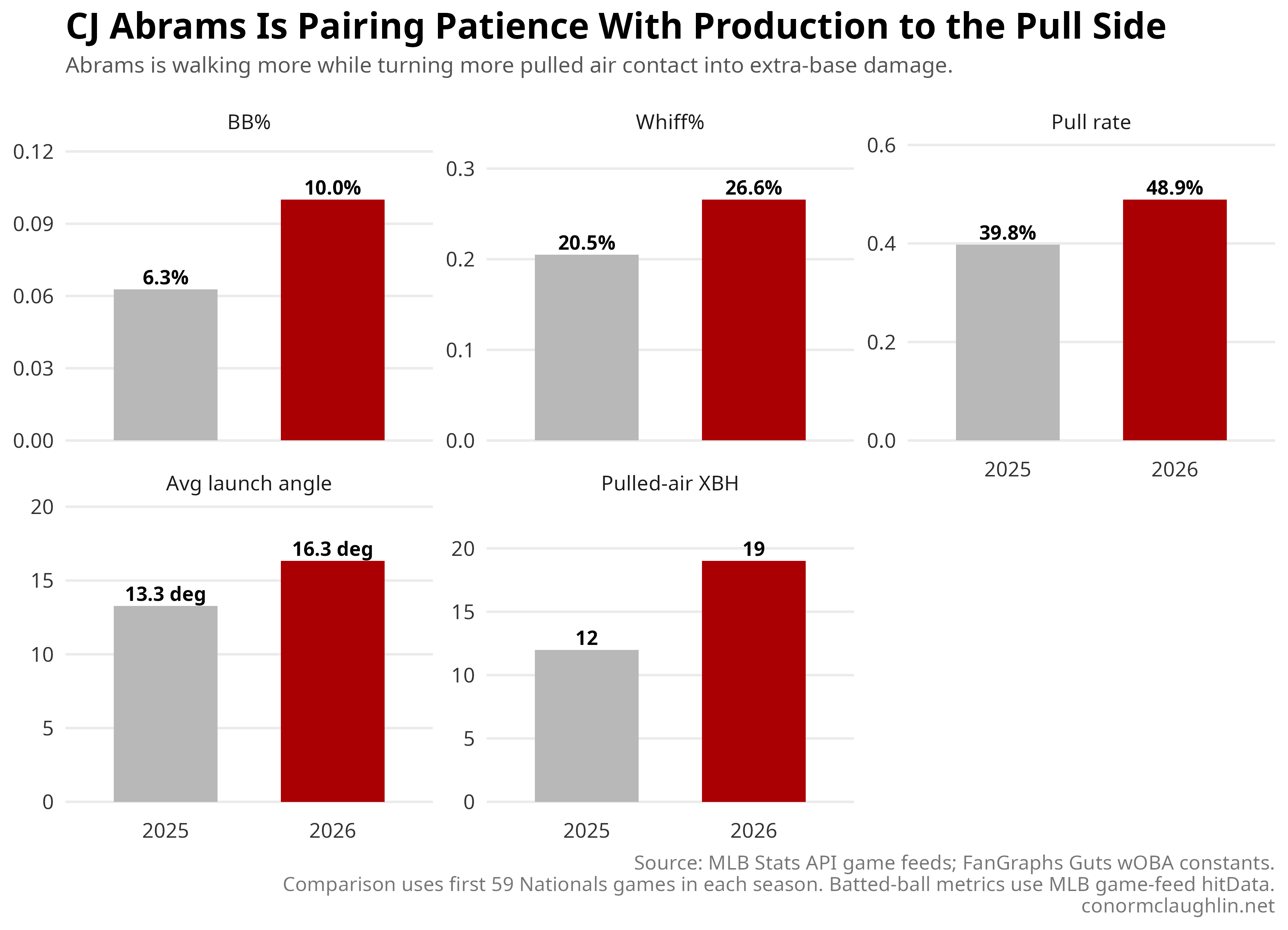
Finally, CJ Abrams, who was already a darn good player, has improved his game this season by becoming more selective at the plate. CJ’s whiff rate is also up - I think this is a function of him making the decision, somewhat like Keibert, to play for a bit more swing and miss when he does swing, which comes through in both his pull rate and extra-base hit figures.
Addition by Subtraction
Last season opened with Josh Bell, Nathaniel Lowe, and Paul DeJong all in regular contributor roles for the team. Unfortunately, while I like some of those guys, all three of them were a negative presence in the lineup. Bell’s unbelievably slow start weighed heavily on the team’s early production and cost the Nats a number of wins early in the season.
This year, Drew Millas and Nasim Nuñez are the biggest drags on the lineup - but in my book, much better to have your backup catcher and fourth infielder be minus bats, rather than your starting DH, 1B, and 3B, as we saw last season.
| Season | Player | Role | PA | Batting Runs |
|---|---|---|---|---|
| 2025 | Josh Bell | DH / 1B | 197 | -4.3 |
| 2025 | Nathaniel Lowe | 1B | 252 | -3.4 |
| 2025 | Paul DeJong | 3B / INF | 57 | -3.7 |
| 2026 | Drew Millas | Backup C | 104 | -6.0 |
| 2026 | Nasim Nuñez | Utility INF | 198 | -11.4 |
Maybe… Pinch Hitting?
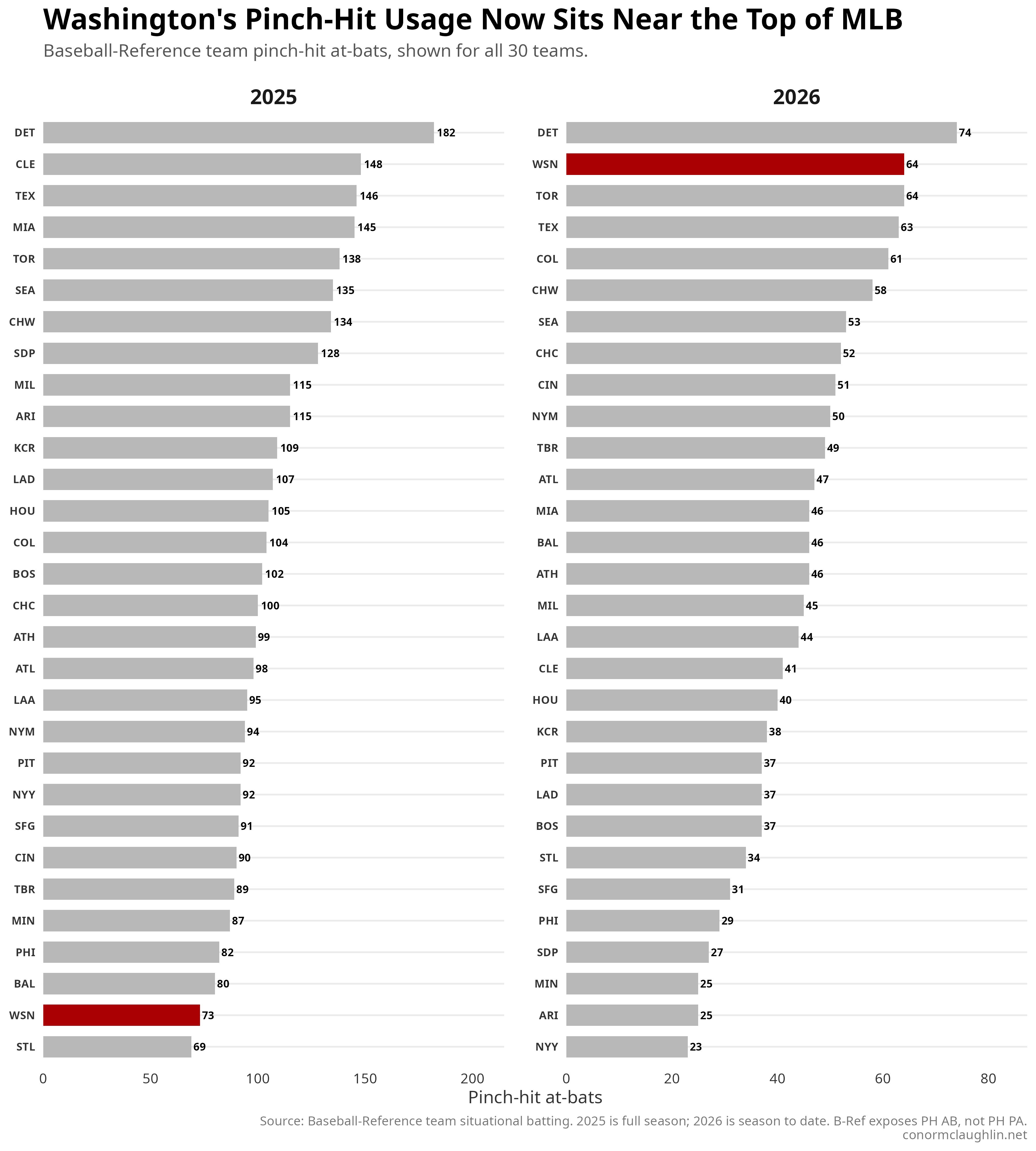
We’re pinch-hitting a ton this season and have gotten some hits in huge moments from pinch hitters. Theoretically, pinch hitting lets the manager play matchups and also shuffle our defense around… even if the advanced metrics don’t show a clear year-over-year change in value per pinch-hit plate appearance, I think it’s been valuable because it keeps the bench engaged and regular at-bats coming their way.
Pitching
While this post is primarily about offense, two interesting pitching trends have emerged this season, as Manager Blake Butera hunts for ways to best utilize his staff. We’ve seen two main trends emerge:
- Utilization of relievers as openers ahead of weaker starting pitchers, to get them more advantageous matchups for their “bulk” outings
- More long relief outings, which help limit the number of unique pitchers used in any given game, and leverage the fact that several relievers in the bullpen were starting pitchers last season
Utilization of Openers
The Tampa Bay Rays popularized the opener a few years ago as a mechanism to pounce on favorable matchups at the top of the lineup (i.e. lefty-lefty) with a high-end reliever, before handing the “bulk relief” off to a traditional starting pitcher.
The Nationals didn’t use a single opener last season, but have been enthusiastic adopters this season with 11 starts by openers thus far this season after 0 last season, led by PJ Poulin with 7 and Richard Lovelady with 3. Those lefties have typically preceded “bulk” outings by Miles Mikolas and Zack Littell - a move that seems to have helped both pitchers settle down after rocky starts to the year.
Shift Towards Longer Relief Outings
Bullpen-wise, Davey Martinez’s tenure with the Nats was marked with extremely traditional utilization - clear roles were established in the bullpen hierarchy and relievers rarely threw more than a single inning at a time. While this rigidity produced clear roles and responsibilities in the pen, it didn’t always produce the best outcomes… aside from the talented 2019 team, it feels like the Nats have had bad bullpens for as long as I can remember.
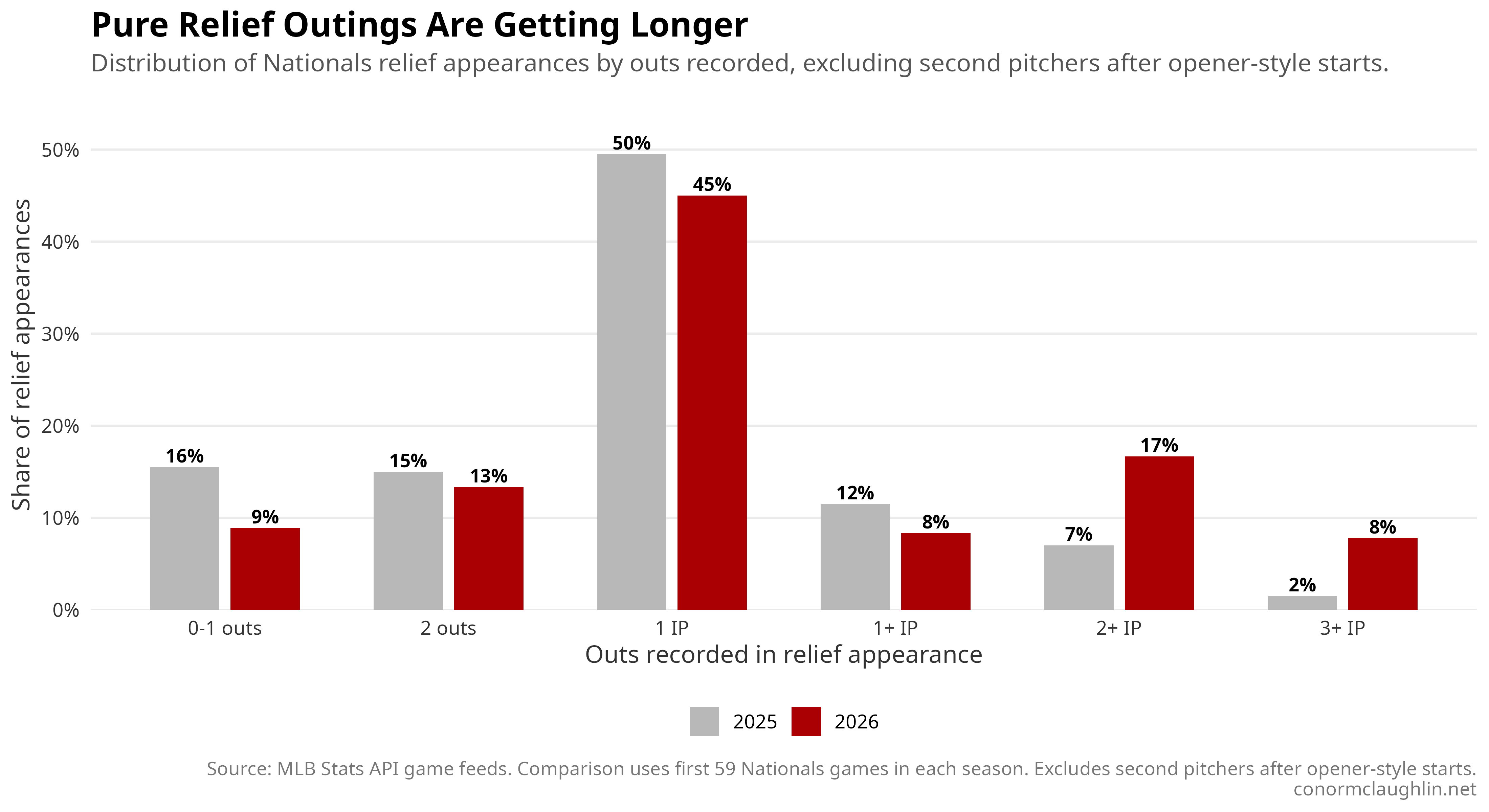
This season, we’ve seen a new strategy emerge - relievers are much more likely to throw 2+ innings (16% of appearances) or even 3+ innings (8% of appearances). The results still are mediocre - this bullpen is not chock-full of talented arms, as the Padres are - but I appreciate the inventiveness and willingness to play to the strengths of the roster… with Brad Lord, Mitchell Parker, and Andrew Alvarez all residing in the pen, the team has arms used to starting who can easily “piggyback” starters for multiple innings - reducing the number of unique pitchers required to navigate through the late innings.